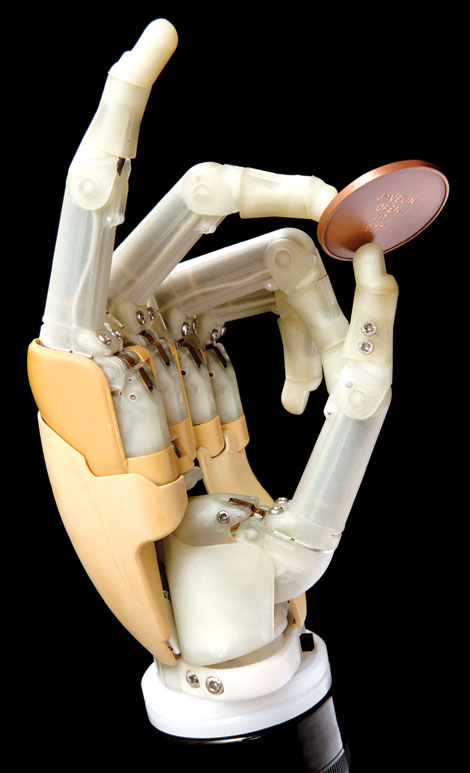
A recent breakthrough in prosthetics could change the future for amputees.
While previous prosthetic devices allowed amputees to grab objects by responding to twitching muscles, amputees could not feel the objects or control the strength of their grip. Now, scientists in Europe have developed a new method of surgically attaching electrodes directly to an amputee’s nerves, allowing the amputee to control grip strength and distinguish different shapes and stiffness of objects.
The scientific study, called Lifehand, was conducted by Swiss biomedical engineer Silvestro Micera, of the Swiss Federal Institute of Technology in Lausanne (EPFL), in cooperation with Scuola Superiore Sant’Anna (SSSA) in Italy. The project built upon previous studies of several new methods of providing a better sense of control and touch for prosthetics used by amputees. The Lifehand project used computer algorithms to take measurements of tension in artificial tendons and convert them into electrical currents.
Micera conducted the test on 36-year old volunteer, Dennis Aabo Sorenson, who lost his left hand in a firework accident 9 years ago. Sorenson’s median and ulnar nerves were connected directly to a robotic hand, allowing him to control the prosthetic hand by using small muscle movements that were detected by electrical signals in his skin. Sorenson was able to grasp objects using different strength grips, and was able to discern the shape and stiffness of various objects even while blindfolded and wearing noise-canceling headphones. Sorenson completed the tests with 67 percent to 93 percent responsiveness.
Sorenson is the first amputee in the world to have sensory information in real-time. A previous clinical trial was conducted in February 2013 with a prototype, and just one year later, Micera was able to perform the surgery to test the bionic arm on a real patient.
Sorenson reported that for the first time in 9 years, he could feel whether objects were hard or soft, round or square using the prosthetic hand. Sorenson’s previous prosthetic hand did not allow for sensory touch or differentiating of objects’ hardness. He described his previous limb as similar to using a brake on a motorbike – when he squeezed the brake, the hand closed, and when he relaxed, the hand opened. He needed to watch the prosthetic to make sure he did not break objects. The new prosthetic, in contrast, allowed Sorenson to feel the objects and control his touch. The test is the first step in creating bionic limbs, although a sensory-enhanced prosthetic limb is still years away from being available for commercial use.
The prosthetic limb was removed from Sorenson’s arm after one month of testing due to safety concerns, but scientists predict that these types of prosthetic limbs could be used safely for many years on amputees in the future.
Sorenson described the test as incredible. He has an optimistic outlook and was happy to participate in the trial to help himself and other amputees. Now he faces the challenge of staying positive after feeling sensory touch for a short time and for the first time in 9 years.