
When you hear the term ‘cyborg’ or ‘cybernetics’, you probably thought of Cyborg the DC Comic Book superhero or maybe RoboCop or even Darth Vader. The vision of merging humans with robotic technology has been around for decades. Now those visions are becoming a reality.
Prosthetic technology has come a long way in recent years. Amputees now have artificial limbs that can function almost as well as natural limbs. It’s amazing to see someone who’s able to tie a shoelace or open a can using artificial limbs that take their cues from existing muscles or just the thoughts of their user. There is even a technology that allows these artificial limbs to restore a sense of touch.
All of these technologies are allowing people to perform normal everyday tasks that have been difficult or required assistance before.
Now let’s take that a step further. What about not so everyday tasks like making music? Rick Allen the drummer for rock band Def Leppard lost his left arm on December 31, 1984 when he was involved in a car accident. He still plays with the band today, thanks to his determination, skill and a modified drum kit.
Today, it is not about modifying the instrument it’s about modifying the prosthetic.
Gil Weinberg a professor at Georgia Tech has created robots that can create music. That’s right, I said create not play. An iPod can play music, but it needs a robot to actually create music. By analyzing existing melodies these musically inclined robots can create new ones. They are on the point of their development where they can jam with human musicians.
So is it too much of a leap to think that Weinberg could create a prosthetic that could do the same?
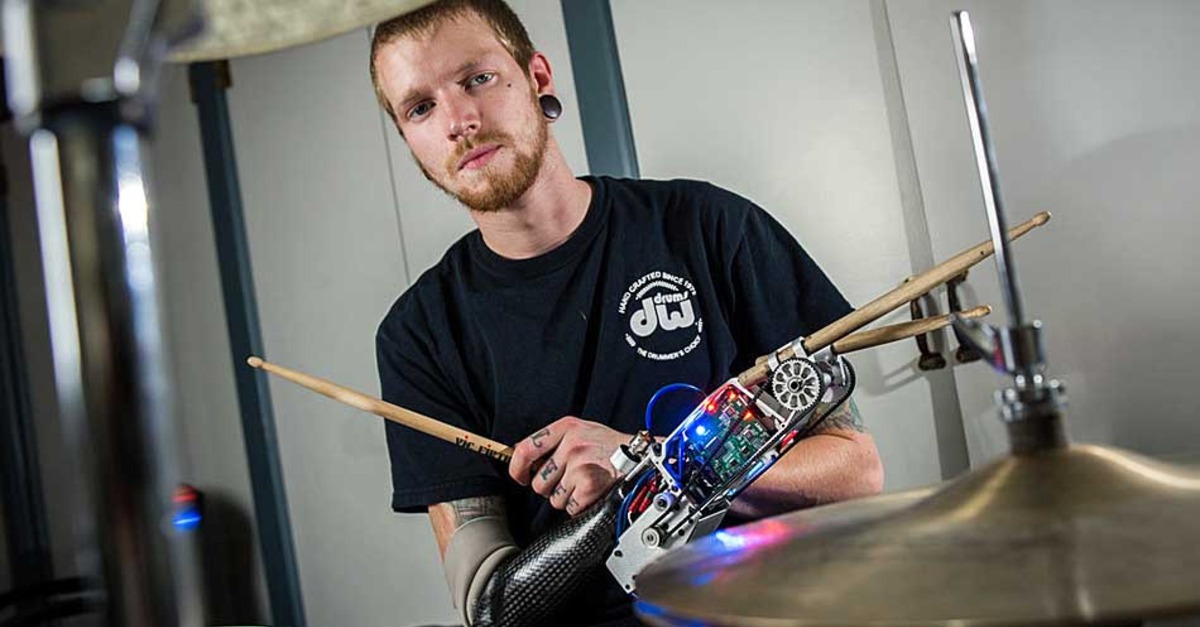
Jason Barnes lost his right arm just below the elbow a few years ago. In his effort to keep playing the drums he designed his own prosthetic. Unfortunately, what he created did not provide the necessary flexibility that a normal wrist and fingers would.
Weinberg then designed a cybernetic arm that takes its cues directly from Jason’s arm using electromyography (EMG) muscle sensors in his upper arm. This new arm has the desired sensitivity that allows for the flexibility a drummer needs to control his grip on the stick.
So Jason’s back on the drums and the story could very easily end here, but it does not.
Remember how Weinberg created robots that can actually create music? So instead of just being contented on giving Jason an arm he can use to play drums, he included a second stick on the arm.
That’s right. Jason’s prosthetic has an extra drumstick. This second drumstick has a mind of its own. It actually listens to what Jason is playing and then backs him up by accompanying him on its own. Jason can’t control what the second stick plays but if he wants to fly solo he can pull it away from the drums.
Weinberg’s ultimate goal is to be able to hook the arm directly to Jason’s brain so it can predict exactly when and whatever Jason wants to play. Then execute a pitch perfect beat.
He has made Jason the drummer of the future. With his robot arm he plays better than a drummer with two human arms, playing faster and with a steadier beat. Not quite Steve Austin but pretty close.
Weinberg’s vision for the future – giving humans who have all their limbs the advantage of an embedded third arm to help astronauts or surgeons with some of their more difficult and delicate tasks. Coming from him.. does not seem all together impossible.