
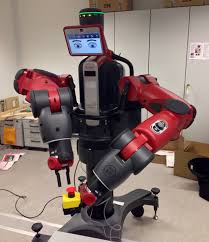
The time is actually upon us where robots are part of the work force. You have probably seen it somewhere, huge robotic arms helping to put together a car for example, but it is not like the future that was dreamed up back in the 50s and 60s. There is not a Rosie out there waiting for you to take her home to clean your house, fix your meals etc. It is not also workers on an assembly line side by side with their automated counterparts.
The challenge with these industrial robots is you should not be in the same room with them. Why? Because these huge metal goliaths of steel and circuitry could end up seriously injuring you or worse, just in the course of doing what they were programmed to do. This also means that if and when something goes wrong you have to power everything down so that you can safely go in and fix the problem causing a loss in productivity.
According to OSHA (Occupational Safety and Health Administration), most robot-related injuries actually occur during those non-routine conditions. When there is a need for someone to go in and fix an issue or do some reprogramming and while in the robot’s ‘personal space’ something unintended happens.
Now there is a solution to all of these: Immersive Virtual Robotics Environment (IVRE), developed at Johns Hopkins’ Computational and Interactive Robotics Laboratory. With funding from National Science Foundation National Robotics Initiative (NRI), researchers have been able to create a prototype that works with an industrial robot. The goal is to make working with robots more accessible to small businesses, allowing these business owners to easily program and work with the robot saving both time and money.
Simply speaking IVRE puts you in a virtual environment where you can interact with the robot without needing to be anywhere near it. This can be done either in real time via a virtual proxy or as a simulation.
What does this mean to the overall use of robots for industrial task? The benefits are actually twofold. It means that you can interact with a robot while it’s doing its job without being within ‘striking distance’. It also means that you can send a robot into an environment that a human would not necessarily want to go into or one that is not safe for humans while keeping a real-time eye on the situation without putting yourself in harm’s way.
Another feature beyond the virtual reality is augmented reality. The operator is not just interacting with the robot. They are also able to receive information about the robot’s environment and what exactly it is the robot is trying to accomplish.
This is just the tip of the iceberg. Imagine someone who does not have a Ph.D. in robotics being able to jump into a virtual world and have a robot perform a task just by showing it what they want it to do, again making this technology more for the masses.
The practical application of this technology hopefully is not too far off. Using Oculus Rift, Virtual Reality software developed by Palmer Luckey, the founder of Oculus VR, makes the technology commercially accessible.
So maybe a future of working side by side with our robotic coworkers is not too far off the mark.