Arduino Lego Band A Youtube Success

Italian sound designer and producer Guiseppe Acito’s new blog was a success after putting up a band to create traffic. This is not your ordinary band like One Directions but a set of LEGO robots hitting the drums under the master control of Guiseppe with the help of Arduino and an ipad midi sequencer app called Nord Beat.

Popularly known as Toa Mata Band, the band creates sounds with different kinds of drums, percussion instruments, synthesizers and a Nintendo DS to cook up a lively beat. The latest video on YouTube has already received almost 20k hits and the reviews are almost positive especially on the Bionicle robot line which has already been discontinued by LEGO.

‘This is the prototype of an ambitious project which I hope I can speak to you in the future,’ he explained.
The first video title is “Toa Mata Band Episode1” and all we can say that there’s more to come from this amazing cute little band.
Smartphones Connects Using RFduino

The developers of the latest coin sized Arduino compatible board believes that the potential are tremendous in terms of applications for   microcomputers that can link to a Smartphone or tablet.

The “RFduino” is an open-source; standalone board that is so versatile it can be conveniently placed in any designs regardless if you’re a hobbyist doing simple projects or an engineer doing designs for a client.

Kazanchian says you can do things like wirelessly monitor temperatures, remotely measure battery voltages, control multicolor LED lighting, drive LCD displays and play with iPhone-controlled RC cars running your Arduino sketches.

The 2.4Ghz board comes with a powerful 32bit ARM Cortex processor and can be turned on by bench power supply, wall outlet, and USB or coin cell battery.

This small coin size “RFduino” was created by electrical engineer Armen Kazanchian of Open Source RF base in Hermosa Beach California.

The “RFduino” is currently posted in Kickstarter trying to find investors to fund the project in large scale production together with its accessory board.

The “RFduino” comes with a Bluetooth v4.0 device that can enable your Smartphone to control and command your project.


Ride the Raptor Arduino Unicycle

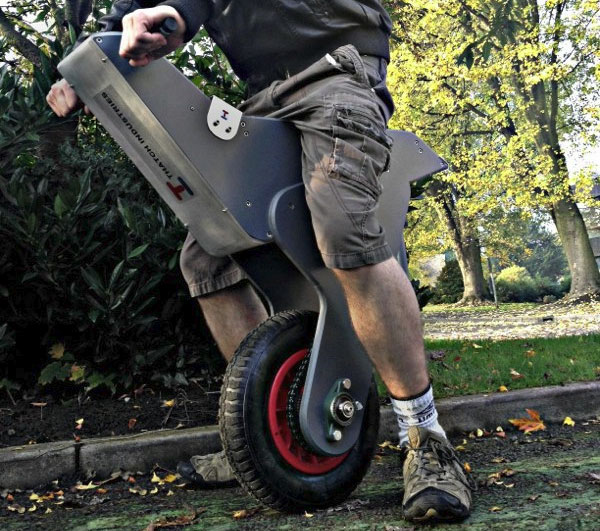
Raptor ArduinoInventor Nick Thatcher was once in a dilemma on what to build: a Segway or a self balancing unicycle ? He later decided to do both but the unicycle came later.

He named the unicycle “Raptor”  because it looks like the head of a dinosaur on the side-view and it’s made from common materials found around: a chain driven wheelbarrow wheel powered by a 350W geared motor with 9:1 reduction gearbox, a pair of 12V 7.2Ah batteries wired in series, some PVC and polycarbonate, an IMU gyro and an Arduino UNO.

Pinoccio – A smaller and more powerful Arduino

Pinoccio - Arduino compatible board
If you love creating DIY Arduino circuits, make sure to check out the Pinoccio Arduino board which comes in a smaller package and has a lots of features.

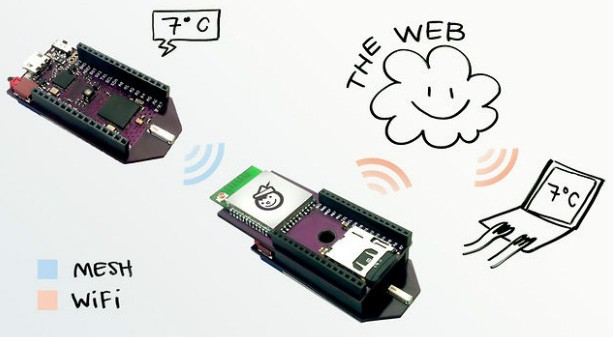
With Arduino’s advantages such as simple programming and cheap materials, no wonder that new projects like Pinoccio are adding special features in order to improve the original design. Pinoccio is powered by a rechargeable battery and it features integrated temperature sensors, integrated MESH radio and WiFi connectivity through a WiFi shield. It can also be used to connect remotely with other Pinoccios, building an internet of things.

Although Pinoccio is just a few inches long and an inch wide, it is still as powerful as the Arduino Mega. This undertaking is campaigning to raise $60000 for this project at Indiegogo.

You can checkout their Indiegogo campaign here: http://www.indiegogo.com/pinoccio

Electric Imp connects your Gadgets to the Web

Electric ImpThe latest Electric Imp has already been released in Beta version and is ready to accept orders of development kits for designers.

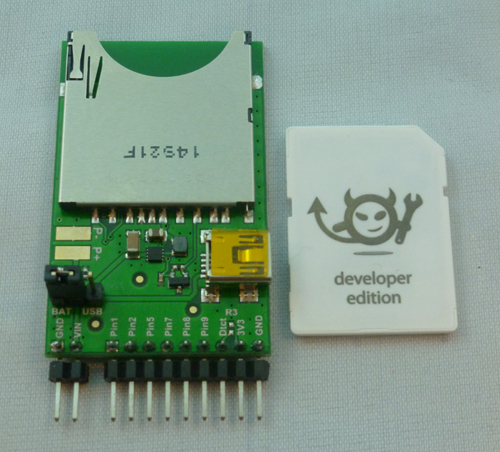
The Electric Imp is an SD-card sized WiFi (802.11b/g/n) module with built-in antenna, 6 I/O, Arm Cortex M3 Micro-controller, and a Cloud-based infrastructure for programming and control. The I/O supports serial, I2C, SPI, A2D, D2A, and PWM interfaces. The Imp uses the Squirrel programming language, which is a small footprint C/C++ derivative for embedded devices.