
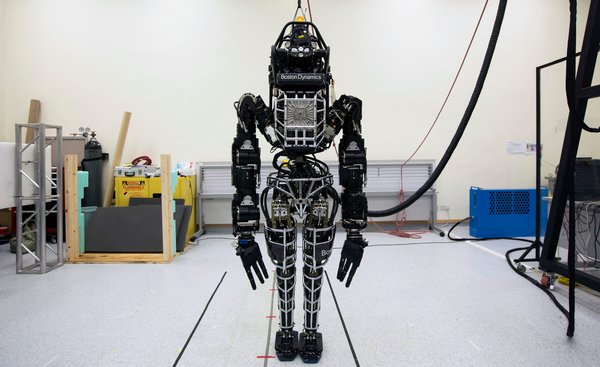
Ninja NAO, Robotic Refueling

Ninja NAO, Robotic Refueling

Imagine that you’re a surgeon getting ready to perform complicated reconstructive surgery on a patient’s eyeball. Now imagine that the patient was over 23,000 miles away from you and their eyeball for some strange reason moves around in circles while you are performing that very complicated surgery. Crazy right? Well, that’s what many people thought about the idea of NASA sending out Robotic Refueling machines into orbit. These RRMs refueled and  repaired new and older satellites in order to advance technology in space.

Phase one discovery of RRMs required engineers to calculate, test, rebundle and retest for accuracy, and longevity of robotic advancements. After a few years of tests, phase one was released. Slowly, engineers worked through the test satellites and needless to say,  they succeeded and now have moved on to phase two!

Now, before we go any further, many of you are probably wondering why is this such a big deal? It is a big deal because once a satellite is launched into space, that is pretty much the end of it. Of course it is monitored, its data is collected, and for a while, it provides everything NASA needs to keep track of the world outside of our own. But what if the satellite incurs damage, runs out of fuel, or malfunctions? It is pretty tough to pin-point the exact location of a satellite as it is orbiting around the earth, no less launching the necessary equipment to repair it.

RRM was designed just for this reason, to send robots out into space to refuel and repair satellites. Going beyond what humans can do physically is definitely a huge leap in the process for the development of future technology. Later on in the year, NASA plans to execute phase two of the RRM. They have already launched RRM hardware to a few satellites and will test it against the operation system of those satellites.

If successful, what could this mean? It could mean that Star Trek is just beginning! With the successful completion of phase two, there could be technology advancements that we only thought possible with special movie effects. Sending out RRMs to keep maintaining satellites decreases metal waste. Instead of leaving an unusable satellite out to the forces of Mother Solar System, it can now be repaired and reused, allowing NASA to focus more on expanding the exploration of the universe beyond where our satellites break down and gain more knowledge of life pass Earth. Now, there will be more opportunities for human-kind and machine to work together.  Also, this improves technology for Communication satellite services like television broadcasts, weather reports, cell phone connections, and much more.  Imagine walking down the street and seeing a television ad broadcasting in midair. How about always having a cell phone signal no matter where you go? So long dropped calls, and ‘no signal’ signs! How about knowing what the weather will be months before you plan for that special summer getaway?

The benefits behind the successful completion of phase two are extremely contributional and can welcome a world of technology that we never thought could be possible. Now imagine again, being the surgeon 23,000 miles away from the patient with the constantly moving eyeball. Does it seem so crazy after all?
Rise of the Ping-Pong Machines?

Rise of the Ping-Pong Machines

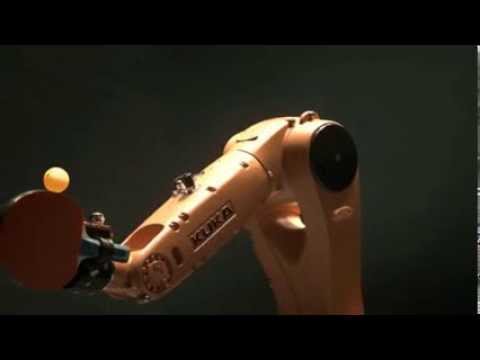
From time immemorial (or at least since the Industrial Revolution), humankind has faced the spectra of competition with its great nemesis: our own machines.  In the nineteenth century people told the story of John Henry, who competed valiantly against a new-fanged steam powered hammer.  He ultimately gave his life in the struggle against the machine, but not before he won the steel-driving contest.  The latest human to take up the mantle of John Henry is none other than ping-pong world champion, Timo Boll.  He is pitted against an industrial robot (the Kuka KR Agilus)  made by the German manufacturer Kuka.  Who will get the triumph?  Will mankind face another humiliating defeat on the heels of our recent loss to IBM’s Jeopardy robot, Watson?

Okay, maybe not.  It turns out this is less the latest entry in the struggle against the machines and just a flashy advertisement for Kuka’s robots.  The robot certainly seems capable of holding the ping-pong paddle and is seemingly able to move it and possibly serve, but there is little evidence it can actually play ping-pong.  It is unclear how or even if the robot is able to detect a ball coming towards it, let alone whether it can coordinate such information with its movements.  What is most apparent is the cinematic camera angles used when Boll begins his furious comeback against the initially intimidating robot.

Timo Boll is a German ping-pong player and former World Cup champion.  He is currently ranked eighth by the International Table Tennis Federation, and he was once ranked first in the world.  He won World Cups twice, in 2002 and 2005, and has enough medals from Olympics, World Championships, and European Championships to fill the German equivalent of Fort Knox.  He is exactly the kind of athlete a company would want to test a ping-pong playing robot against.  However, he may also be the kind of athlete a company might want to help advertise their industrial robot.

There are a number of examples of professional robotics researchers and engineers working on advancements that could enable a robot to play ping-pong. A team from the Ishikawa Komuro Lab has demonstrated that a robot can track the movement of a ball with the right cameras.  Additionally, a number of other groups have demonstrated that robots can paddle the ping-pong ball back and forth, both with other robots and with humans attempting to play casually rather than competitively with them.

Perhaps it is harsh to point out the shortcomings of Kuka’s ping-pong playing robot.  After all, it is simply a commercial for their line of industrial robots.  Their KR Agilus robots are undoubtedly more than capable of the industrial tasks they typically perform.  However, Kuka did choose to advertise in this way, and they had to know what people would think of IBM’s Deep Blue and Watson, not to mention Skynet.  So kudos to them for an interesting commercial, but next time, we want to see a real game of ping-pong between people and robots.

Control VR – A Gamer’s Dream Possession

ControlVR1


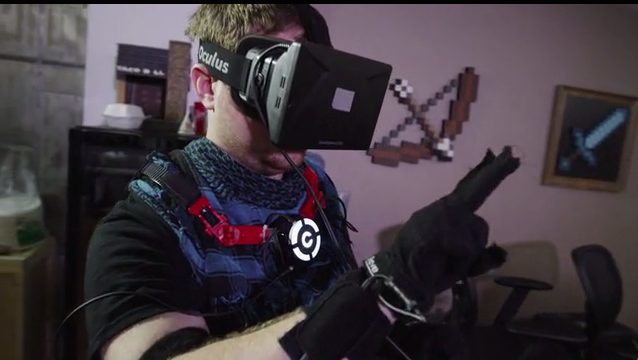
Control VR is a wearable technology that gives your hands the ability to turn into a controller. It also gives the user great taste of the virtual world.

The project has raised almost $440,000 on its Kickstarter page.


[to be continued]

IRF520 Driver Module

Technical specifications:

  • Maximum voltage: 24V;

  • Maximum current: 5A (1A for more than you need to ensure heat dissipation);

  • Gate voltage: 3.3V, 5V;

  • Low switching times;

  • R DS : 0.27 ohms;

  • Task goal: 16nC.

Dimensions: 33 x 24mm.

IRF520 power transistor module is suitable in your projects you need to control with low impedance loads such as LED power or engines, and to switch to high frequency, so you can not use a relay. The module is designed to switch heavy DC loads from a single digital pin of your microcontroller.


50 pcs 40p 2.54 mm Pitch Male Pin Header – Yellow

Overview

A pin header is consists of one or more rows of male pins typically spaced 2.54 millimetres (0.1 in) apart, but 5.08 millimetres (0.2 in), 5.00 millimetres (0.197 in), 3.96 millimetres (0.156 in), 2.00 millimetres (0.079 in), 1.27 millimetres (0.05 in) or 1.00 millimetre (0.04 in) are common as well. Pin headers are often associated with ribbon cable connectors. Pin headers are cost-effective due to their simplicity. Headers are often sold as long strips (typically 40 or 50 pins for the dual row versions) which can easily be broken off to the right number of pins.

Specifications:

• Single-row, 40-pin, straight male header strip
• Gender: Male
• Pin Type: Straight
• Color: Yellow
• Condition: New product