
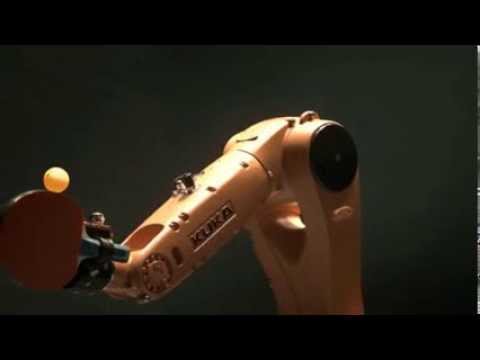
From time immemorial (or at least since the Industrial Revolution), humankind has faced the spectra of competition with its great nemesis: our own machines. In the nineteenth century people told the story of John Henry, who competed valiantly against a new-fanged steam powered hammer. He ultimately gave his life in the struggle against the machine, but not before he won the steel-driving contest. The latest human to take up the mantle of John Henry is none other than ping-pong world champion, Timo Boll. He is pitted against an industrial robot (the Kuka KR Agilus) made by the German manufacturer Kuka. Who will get the triumph? Will mankind face another humiliating defeat on the heels of our recent loss to IBM’s Jeopardy robot, Watson?
Okay, maybe not. It turns out this is less the latest entry in the struggle against the machines and just a flashy advertisement for Kuka’s robots. The robot certainly seems capable of holding the ping-pong paddle and is seemingly able to move it and possibly serve, but there is little evidence it can actually play ping-pong. It is unclear how or even if the robot is able to detect a ball coming towards it, let alone whether it can coordinate such information with its movements. What is most apparent is the cinematic camera angles used when Boll begins his furious comeback against the initially intimidating robot.
Timo Boll is a German ping-pong player and former World Cup champion. He is currently ranked eighth by the International Table Tennis Federation, and he was once ranked first in the world. He won World Cups twice, in 2002 and 2005, and has enough medals from Olympics, World Championships, and European Championships to fill the German equivalent of Fort Knox. He is exactly the kind of athlete a company would want to test a ping-pong playing robot against. However, he may also be the kind of athlete a company might want to help advertise their industrial robot.
There are a number of examples of professional robotics researchers and engineers working on advancements that could enable a robot to play ping-pong. A team from the Ishikawa Komuro Lab has demonstrated that a robot can track the movement of a ball with the right cameras. Additionally, a number of other groups have demonstrated that robots can paddle the ping-pong ball back and forth, both with other robots and with humans attempting to play casually rather than competitively with them.
Perhaps it is harsh to point out the shortcomings of Kuka’s ping-pong playing robot. After all, it is simply a commercial for their line of industrial robots. Their KR Agilus robots are undoubtedly more than capable of the industrial tasks they typically perform. However, Kuka did choose to advertise in this way, and they had to know what people would think of IBM’s Deep Blue and Watson, not to mention Skynet. So kudos to them for an interesting commercial, but next time, we want to see a real game of ping-pong between people and robots.